







Dieting for men vs women: key biological differences explain why the same diet plan can lead to fast results for one gender and frustration for the other. This isn’t about motivation or effort—it’s about biology. Men and women are built differently at a hormonal, metabolic, and physiological level, and those differences strongly influence how the body loses fat, uses calories, and responds to dieting.
At My Diet Way, we focus on real bodies and real science—not generic advice. Understanding these differences helps you stop following plans that work against your biology and start eating in a way that actually supports it.
This guide breaks everything down clearly, practically, and without complicated medical language.
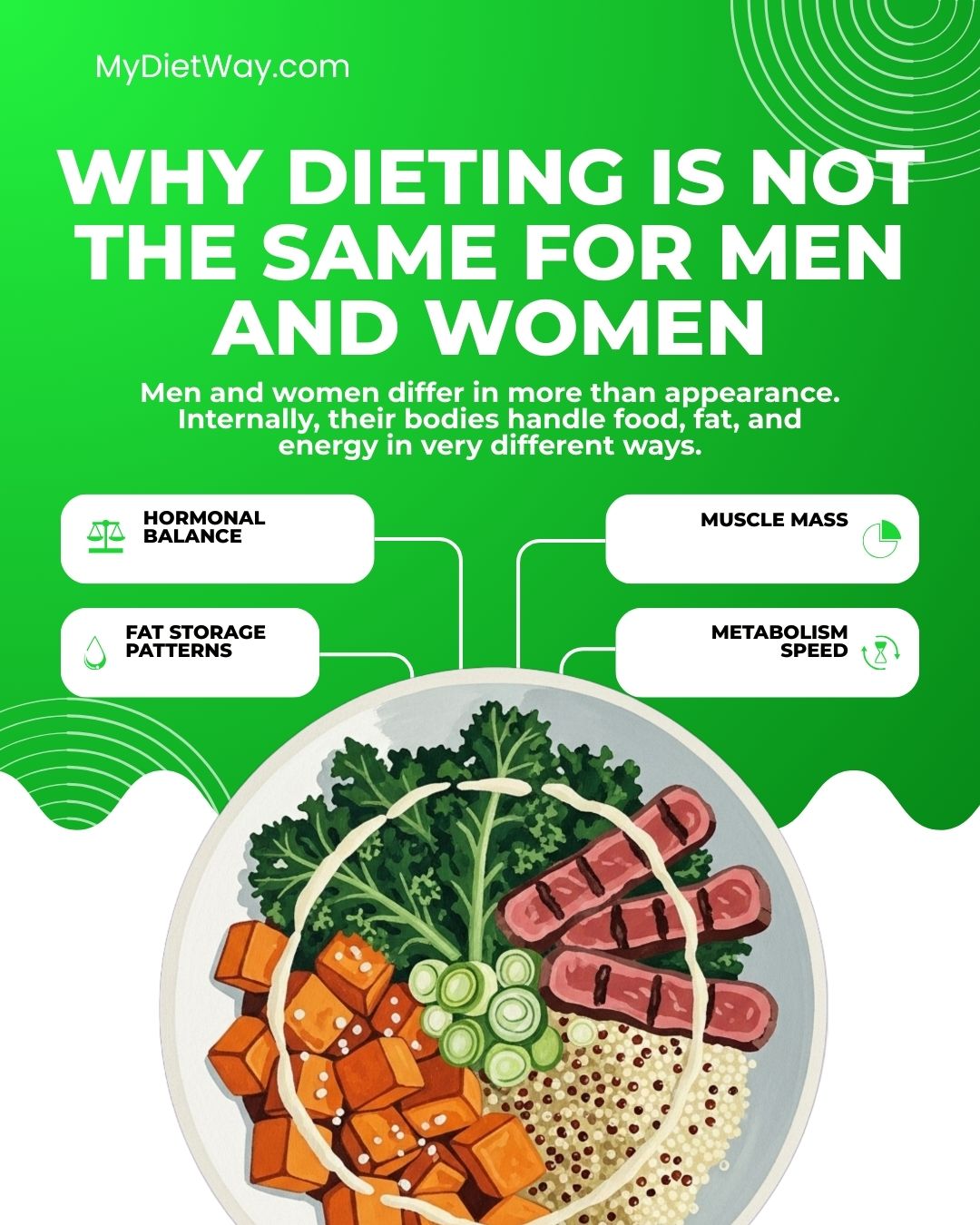
Why Dieting Is Not the Same for Men and Women
Men and women differ in more than appearance. Internally, their bodies handle food, fat, and energy in very different ways.
Key differences include:
-
Hormonal balance
-
Muscle mass
-
Fat storage patterns
-
Metabolism speed
-
Appetite regulation
Ignoring these differences is one of the biggest reasons diets fail.
1. Muscle Mass Differences and Calorie Needs
Men naturally carry more lean muscle mass than women. Muscle burns more calories at rest, which gives men a higher baseline calorie burn.
What This Means for Dieting
| Factor | Men | Women |
|---|---|---|
| Muscle mass | Higher | Lower |
| Resting calorie burn | Higher | Lower |
| Calorie tolerance | More flexible | More sensitive |
Men can often eat more calories and still lose weight, while women may need more precision.
👉 Related article: How Metabolism Speed Affects Your Ideal Diet Choice
2. Hormonal Differences That Affect Fat Loss
Hormones play a massive role in dieting success.
Key Hormones in Men
-
Testosterone (supports muscle and fat loss)
-
Lower estrogen levels
-
More stable hormonal patterns
Key Hormones in Women
-
Estrogen
-
Progesterone
-
Cortisol sensitivity
-
Monthly hormonal fluctuations
Women experience hormonal shifts throughout the menstrual cycle, which can affect hunger, cravings, and water retention.
A diet that ignores female hormone cycles often leads to burnout or stalled progress.
3. Fat Storage Patterns Are Biologically Different
Men and women store fat in different areas due to genetics and hormones.
Typical Fat Storage
-
Men: Abdominal (belly fat)
-
Women: Hips, thighs, glutes
Abdominal fat tends to respond faster to calorie reduction, which is why men often see quicker visual results early on.
Women’s lower-body fat is more hormonally protected, making it slower—but not impossible—to lose.
4. Metabolism and Energy Conservation
Women’s bodies are naturally more efficient at conserving energy. This is an evolutionary adaptation designed to support reproduction.
Dieting Impact
-
Women are more sensitive to calorie restriction
-
Severe dieting can slow metabolism faster in women
-
Men tolerate aggressive deficits more easily (short-term)
This is why extreme low-calorie diets tend to backfire harder for women.
👉 Learn more: The Complete Guide to Fasting Diets: Benefits, Methods, Risks, and Results (2025)
5. Hunger and Appetite Regulation
Appetite hormones behave differently between genders.
Hunger Differences
| Aspect | Men | Women |
|---|---|---|
| Hunger signals | More straightforward | More hormone-influenced |
| Cravings | Often calorie-driven | Often emotion/hormone-driven |
| Response to fasting | Better tolerance | Mixed response |
Women are more likely to experience intense cravings during certain cycle phases, especially for carbohydrates and sweets.
👉read this: 7 Science-Backed Ways Metabolism speed affects Your Ideal Diet (What Most Diets Get Wrong)
6. Exercise Response and Diet Synergy
Men and women respond differently to exercise—and that changes diet needs.
Men
-
Build muscle faster
-
Benefit from higher protein intake
-
Burn calories more aggressively with strength training
Women
-
Build muscle more slowly
-
Benefit from recovery-focused nutrition
-
Overtraining can increase cortisol and stall fat loss
Women often see better results with balanced training rather than excessive cardio.
7. Stress, Cortisol, and Dieting
Women are generally more sensitive to cortisol, the stress hormone.
Why This Matters
-
High stress increases fat storage
-
Cortisol spikes increase cravings
-
Poor sleep impacts women’s weight more severely
Dieting under high stress can completely block fat loss—especially for women.
👉 Related read: Genetic Factors That Influence Weight Loss Success: What Science Says in Simple Terms in 2026
8. Best Diet Approaches for Men vs Women
Dieting Tips for Men
-
Higher protein intake
-
Moderate calorie deficits
-
Strength training focus
-
Flexible carb intake
Dieting Tips for Women
-
Avoid extreme calorie restriction
-
Cycle calories with hormones
-
Prioritize protein and fiber
-
Manage stress and sleep
Side-by-Side Comparison
| Diet Factor | Men | Women |
|---|---|---|
| Calorie deficit | Moderate to high | Small to moderate |
| Protein needs | High | Moderate to high |
| Fasting | Often effective | Situational |
| Carb tolerance | Higher | Cycle-dependent |
Common Dieting Mistakes by Gender
Common Mistakes Men Make
-
Ignoring food quality
-
Overeating on weekends
-
Relying only on exercise
Common Mistakes Women Make
-
Eating too little
-
Excessive cardio
-
Ignoring hormonal signals
Both lead to plateaus—but for very different reasons.
Should Men and Women Follow the Same Diet Plans?
Short answer: No.
While healthy foods are universal, how and when they’re eaten should reflect biological differences. A diet that works perfectly for a man may stall fat loss or damage hormone balance in a woman.
At My Diet Way, we focus on personalization—not gender stereotypes, but biological realities.
🌿 Explore more at: https://mydietway.com/
Frequently Asked Questions (FAQ)
Do men lose weight faster than women?
Often yes, due to higher muscle mass and testosterone—but long-term success depends on habits.
Why do women hit plateaus more often?
Hormonal shifts, stress, and metabolic adaptation play major roles.
Is fasting bad for women?
Not always, but it must be approached carefully and individually.
Should women eat fewer carbs than men?
Not necessarily—carb needs can change throughout the menstrual cycle.
Can women diet aggressively like men?
Short-term, sometimes. Long-term, it often leads to hormonal imbalance.
Final Thoughts
Understanding dieting for men vs women: key biological differences is not about creating division—it’s about creating better results. When diets respect biology instead of ignoring it, weight loss becomes more sustainable, less stressful, and far more effective.
There’s no universal diet—only the right strategy for your body.
That’s the foundation of everything we do at My Diet Way.
We Help this article to